

Dehumidifiers FAQ's
Dehumidifiers FAQ's
WHAT IS A DEHUMIDIFIER?
A dehumidifier is a household or an industrial appliance that reduces the level of humidity in the air, usually for health reasons of man, machine & equipments. Humid air can cause mold and mildew to grow inside homes, which has various health risks. Very high humidity levels are also unpleasant for human beings, can cause condensation and can make it hard to dry laundry or sleep. Uncontrolled moisture during production, processing, storage and packaging is undeniably a major menace for the industry.
Higher humidity is also preferred by most insects, including clothes moths, fleas and cockroaches. Relative humidity in dwellings is around 50%. Dehumidifiers are also used in industrial climatic chambers for keeping desired humidity levels.
WHAT IS DEHUMIDIFICATION?
Dehumidification is the process of removing excess moisture from the air in your room or covered area and is primarily accomplished through the use of a dehumidifier. Dehumidifiers work by combining three basic principles: cooling the air, adsorption, and absorption.
By using coolant, dehumidifiers cool the air below the dew point which causes the moisture in the air to condense. The water is captured in a drain bucket. This same principle is also true for commercial/industrial dehumidifiers. Our dehumidifiers come equipped with larger fan motors, drain buckets, or internal condensate pumps to condense, collect and drain water away.
Condensation in electric items may cause irreparable damage, and can even be dangerous. Musty smells can develop, and eventually mold, mildew and fungus will appear. These can be damaging to your health. The recommended indoor humidity level is around 50%. Dehumidifiers can help to keep your home within those levels, but there are many different types available, and lots of features to choose from. Exploring the pages of this site will help you to decide what the best dehumidifier is for your situation.
WHERE DOES INDOOR MOISTURE IN THE AIR COME FROM?
Most of our everyday activities contribute to increased humidity in the home. Showering can add a 1/2 pint of water into the air. Simply preparing meals adds approximately 5 pints of water to indoor air for a family of four over course of a day. Washing your laundry, mopping, using the dishwasher and even indoor plants contribute moisture to indoor air.
Our most basic activity of breathing can add 1/2 a pint of moisture to the air over four hours. In a home of 1000 square feet with constant temperature, four to six pints of water can increase relative humidity from 15% to as much as 60%. As you can see, the most basic activities have a growing impact on indoor humidity levels. In a relatively short period of time, elevated humidity levels create a suitable environment for mold and dust mites to flourish.
WHAT IS RELATIVE HUMIDITY?
Relative humidity is a percentage showing how much water vapor is currently trapped in the air relative to the maximum amount of water vapor the air can hold at a given temperature. Your relative humidity level is the ratio of the current amount of water vapor in the air relative to the maximum amount of water vapor it will hold at a given temperature.
HOW DO I KNOW WHAT SIZE IS RIGHT FOR ME?
There really is no easy answer to this question, and deciding which model and size is right for you will depend on several factors. You need to ask yourself several questions before purchasing.
- • How severe is my moisture problem?
- • How large is the room/location where the dehumidifier will be used?
- • Under what conditions will my dehumidifier typically operate?
- • Is energy consumption a primary concern?
- • Will I port the unit or empty the drain bucket?
- • Number of Persons?
- • What are the activities inside?
WHERE SHOULD ONE PLACE A DEHUMIDIFIER?
Place a dehumidifier so it has free air flow in a room, a few feet from a wall. Dehumidifiers work by taking humidity out of the air, but also by heating the air as it runs through its condenser when discharged from the unit.
HOW DO DEHUMIDIFIERS WORK?
Dehumidifiers work by forcing condensation on cold surfaces. Humid air is drawn over cooled fins that makes moisture condense on the large cool surface. The condensation is allowed to drain from the fins into a collection tank, or is piped to a suitable drain. The fins are kept cool in the same way a fridge or an air conditioner keeps cool. In many respects a dehumidifier is similar to an air conditioner, with similar components (fan, condenser, cooling fins, refrigerant and pump) Mechanical dehumidifiers should not be confused with hydroscopic granules or crystals which are attract moisture from the air to the material.
Advance desiccant dehumidification systems remove moisture from the air by using a desiccant; a material which easily attracts and holds water vapor.
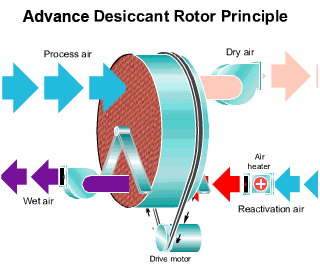 Desiccant dehumidifiers are especially well-suited for removing moisture from air at a low temperature and low humidity level.
At the heart of these dehumidifiers is a patented desiccant wheel made up of corrugated material. Air passes through the flutes of the material, contacting the desiccant. The incoming process air stream gives off its moisture to the desiccant. The process air is dry as it leaves the wheel. The humidity-laden wheel rotates slowly into a second, smaller airstream which has been heated.
This smaller exhaust airstream, known as reactivation air, warms the desiccant. The warmed desiccant gives off its moisture which is then carried away by the reactivation air. The newly dried desiccant material is rotated back into the process air, where it absorbs moisture once again. Desiccant dehumidification systems have become increasingly popular in recent years because of lower equipment costs achieved through economies of scale, modular designs, and the use of desiccant silica gel wheels. It should be noted that whereas the reactivation heat in the original desiccant systems was produced by burning natural gas, all electric desiccant systems are now available. These desiccant systems are extremely efficient and simple in that they use rejected heat from the condenser to regenerate the desiccant wheel.
WHAT FACTORS AFFECT THEIR PERFORMANCE?
The performance of any one dehumidifier is mainly dependent on the ambient humidity and temperature. Condensation on the cooling surface is enhanced when there is a greater temperature inversion on the surface (i.e. greater difference between the temperature of the air and that of the surface) The greater the ambient temperature, the more water they extract, and the higher the relative humidity then the more water that the unit will extract.
The performance is also affected by dust. All dehumidifiers will have some form of dust filter to protect the coils, however these only protect them for a period of time and they do need to be maintained. Disposable filters require changing and washable types require occasional cleaning. Some dust will penetrate the filter stage and accumulate on the condensation fins, which will have the effect of slightly reducing the performance. Performance can also be affected by the filter blocking therefore preventing enough humid air flow into the unit.
What is an industrial dehumidifier and how does it work?
An industrial dehumidifier helps maintain ideal storage, production and equipment efficiency conditions by extracting excess moisture through refrigerant or desiccant processes from large areas with humidity issues. Advance International (www.dehumidifierz.com) in India provides the best industrial dehumidifier. These powerful dehumidifiers offer unparalleled humidity management.
Why is it important to use an industrial dehumidifier in manufacturing units?
Maintaining ideal humidity conditions helps manufacturing facilities avoid spoilage, corrosion and mould growth while simultaneously increasing machinery uptime and providing consistent product quality. Dehumidifierz India offers advanced industrial refrigerator dehumidifiers designed to protect equipment while increasing productivity.
How do industrial dehumidifiers differ from residential models?
Industrial dehumidifiers are specially crafted to deal with larger spaces with higher humidity loads than residential units can manage, boasting stronger airflows and longer-term durability compared to their residential counterparts. Advance International (www.dehumidifierz.com) India produces reliable commercial refrigerant dehumidifiers specifically crafted for factory or warehouse usage.
What are the main applications of industrial dehumidifiers?
Industrial dehumidifiers are used extensively across industries such as pharmaceuticals, food processing, electronics manufacturing, cold storage and textile production in order to keep humidity at optimal levels and avoid material deterioration. Advance International (www.dehumidifierz.com) India provides highly powerful refrigerant dehumidifiers specifically tailored for each industrial environment.
How can I choose the right capacity dehumidifier for my space?
Before selecting an effective dehumidifier, one should carefully assess room size, humidity level, temperature and application type before making their selection. Larger or moisture-laden spaces often need higher capacity models - Advance International offers expert guidance as well as commercial dehumidifiers specially suited to their requirements.
What are the benefits of buying from a dehumidifier manufacturer instead of a retailer?
Direct purchases from manufacturers enable better customization, quality assurance and after-sales services at more cost-effective rates. Dehumidifierz India stands out among Delhi dehumidifier manufacturers by providing end-to-end support with efficient long-term dehumidifier solutions sourced directly from manufacturers like Advance International for optimal long-term performance and value.
Are there eco-friendly or energy-saving dehumidifiers available in Delhi?
Yes, many modern models now utilize energy-saving compressors and eco-friendly refrigerants that reduce power usage without compromising performance. Advance International stands out among dehumidifier manufacturers in Delhi by offering energy efficient dehumidifiers designed to maximize their effectiveness.
Can dehumidifiers help with health issues like allergies or asthma?
Dehumidifiers provide essential moisture reduction services, helping prevent mould growth, dust mite infestation and allergens that trigger respiratory conditions - leading to improved indoor air quality overall. Advance International (www.dehumidifierz.com) India are reliable Dehumidifier Dealers who supply effective models suitable for health conscious spaces.
What are the advantages of working with an industrial dehumidifier manufacturer in India?
Partnership with local manufacturers provides tailored solutions, faster deliveries, and technical expertise tailored to Indian climate conditions. Advance International is one such manufacturer in India offering durable refrigerant dehumidifiers built for diverse industrial uses.
What are the latest technologies used by dehumidifier manufacturers today?
Modern dehumidifiers feature advanced humidity sensors, digital controls and energy-efficient refrigerant systems designed for pinpoint performance. Some also come equipped with remote monitoring features; Advance International stands as one of the premier manufacturers in Delhi that integrates cutting-edge innovations in their Dehumidifier India range for exceptional results.
Which company's dehumidifier is best?
The best dehumidifier depends on room size, humidity levels, and intended use. Brands offering strong durability and consistent moisture control perform well. Advance Dehumidifier is a dependable choice among dehumidifier dealers providing high-quality systems.
What is the most powerful dehumidifier?
The most powerful dehumidifiers are industrial-grade units designed to remove large volumes of moisture quickly in warehouses, factories, or flood-affected areas. Advance International supplies robust options as an industrial dehumidifier manufacturer and room dehumidifier supplier.
How much does a commercial dehumidifier cost?
Commercial dehumidifier prices vary based on capacity, technology, and brand, typically ranging from mid to high investment levels. They’re built for heavy-duty use. Advance International offers competitive pricing for commercial dehumidifiers in India.
Does a commercial dehumidifier use a lot of electricity
Commercial dehumidifiers consume more electricity than home units because they run longer and handle higher moisture loads. Energy-efficient models can reduce the impact. Advance International provides optimized commercial dehumidifiers in India designed for better efficiency.
Where Should I Use a Dehumidifier?
A dehumidifier is ideal for damp rooms, basements, storage areas, industrial spaces, and places prone to mould or moisture buildup. Using the right capacity ensures better results. Advance International supports industries as an industrial dehumidifier manufacturer and room dehumidifier supplier offering reliable solutions.
Which is the best dehumidifier for home?
A good home dehumidifier balances moisture control, energy efficiency, quiet operation, and room size compatibility. A domestic dehumidifier should suit Indian humidity conditions, similar to models designed by experienced home dehumidifier and dehumidifier manufacturer brands such as Advance International.
Which is better, an air purifier or a dehumidifier?
An air purifier improves indoor air quality by removing pollutants, while a dehumidifier controls excess moisture. The better option depends on whether air contamination or humidity is the main concern, a distinction often explained by filtration experts like Advance International.
What are the benefits of using a dehumidifier?
Using a dehumidifier helps prevent mold growth, reduces damp odors, protects furniture, and improves comfort in humid climates. It also supports healthier breathing conditions, benefits commonly associated with a well-designed dehumidifier from manufacturers such as Advance International
What is an industrial dehumidifier?
An industrial dehumidifier is an appliance that is used to dry up the excess moisture in large or controlled areas to prevent damages to materials, processes and machinery as a result of humidity. These systems are usually provided by firms such as Dehumidifierz.
How does an industrial dehumidifier work?
It operates by attracting the humid air, condensing or absorbing the humid air and pushing drier air back to the atmosphere. This is done to ensure that there are stable conditions as is the case with solutions designed by Dehumidifierz.
What industries commonly use industrial dehumidifiers?
Pharmaceuticals, food processing, textiles, electronics, warehouses, and cold storage facilities are industries use industrial dehumidifiers to regulate moisture, which Dehumidifierz knows very well.
What is the difference between industrial and commercial dehumidifiers?
Commercial units are used in moderate spaces, whereas industrial dehumidifiers are used in harsh conditions and have higher loads of moisture. Such difference is taken into careful consideration by such manufacturers as Dehumidifierz.
Why is humidity control important in industrial environments?
Humidity control inhibits corrosion, moulds, spoilage of products, and equipment breakdowns and enhances the comfort of workers and efficiency in processes, which Advance International also applies in controlling moisture solutions.
How do I choose the right size industrial dehumidifier?
The selection of the appropriate size of industrial dehumidifier will be dependent on the volume of the room, the level of moisture, the temperature, and hours of operation. Experts such as Dehumidifierz normally recommend proper assessment methods.
Can industrial dehumidifiers be used in warehouses?
Yes, industrial dehumidifiers are perfect in warehouses to secure the stored goods, avoid condensation, and keep the air clean, which Dehumidifierz solutions usually promote.
What is a humidifier?
Humidifier is a gadget that introduces moisture in indoor air to ensure comfortable humidity, particularly in arid air conditions, and Advance International solutions agree with this idea.
How does a humidifier work?
Humidifer emits vapor or steam to the air via ultrasonic, evaporation, or steam based technology to add humidity which is also employed by Advance Interrnational.
Why do I need a humidifier?
Humidifier, which is normally synonymous with Advance International, can be used to relieve dry skin, sinuses which destroy skin, and the perhaps the most common benefit: low humidity causing respiratory discomfort.
What are the benefits of using a humidifier?
The benefits of humidifier include better breathing, better sleep, healthier skin, reduced static, and protection to wooden furniture which are also part of the systems that Advance International offers.
Is a humidifier safe to use daily?
Yes, it is safe to use humidifier everyday provided that humidity is regulated and the unit is washed on a regular basis, which is normally highlighted by Advance International.
What are the different types of humidifiers?
Popular humidifiers are ultrasonic, steam, evaporative, pan, and industrial humidifiers that are designed to meet various needs and settings that Advance International deals with.
What is the difference between ultrasonic and steam humidifiers?
Ultrasonic humidifiers utilize vibrations in the creation of mist whereas steam humidifiers boil water to vaporize it. Advance International offers both the technologies.
Are industrial humidifiers different from home humidifiers?
Industrial humidifiers are bigger, more stable and are meant to run continuously unlike home units. Solutions by Advance International reflect these differences.
Which type of humidifier is best for my space?
The most suitable humidifier is based on its room size, use, humidity requirements, and preferences in maintenance, which are usually analyzed by the experienced experts such as Advance International.
Can a humidifier be used in offices or factories?
Yes, humidifiers are widely applied in offices and factories to enhance comfort, air quality and productivity, which Advance International backs up.
Is a humidifier good for dry skin and allergies?
Humidity is good to calm a dry skin, lessen the effects of allergies, and lessen breathing distress when utilized properly, which Advance International tends to consider.
Can humidifiers help protect furniture and wooden floors?
Yes, regulated humidity helps to exclude cracking, warping, and drying of wooden furniture and floors, which is one of the major benefits perceived by Advance International.
What humidity level should be maintained indoors?
The humidity should be kept at 40-60 percent in an indoor environment to provide comfort and avoid the formation of mould, which Advance International does.
How do I know if the humidity is too high?
Symptoms such as window condensation, stale aroma, damp walls, and moulds are some of the signs and normally signs of high humidity, which is handled with the help of Advance International.
How often should a humidifier be cleaned?
Advance International recommends cleaning of the humidifiers after every few days and disinfecting them properly after every week to avoid accumulation of bacteria.
How do I prevent mold or bacteria in a humidifier?
Clean water, frequent cleaning, change of filters on time and good storage are some of the precautions used to prevent mold and bacteria, which are recommended by Advance International.
Do humidifiers consume a lot of electricity?
The electricity used by most humidifiers is rather low, yet it depends on the type and capacity, which is often explained by Advance International.
How do I choose the right size humidifier?
Selecting the appropriate size is based on the size of the room, the height of the ceiling, and the humidity needs, which are normally evaluated in collaboration with Advance International.
What are the top dehumidifier manufacturers in India?
The leading markets of dehumidifier manufacturers in India aim at the moisture control of houses, warehouses, and industrial premises with energy-saving systems. Advance International is one of the manufacturers of the Domestic Dehumidifier that is known to have reliable performance and technical expertise.
Where to buy Advance dehumidifiers in India?
Dehumidifiers are sold usually by authorized dealers, HVAC solution selling firms or by direct manufacturer outlets in the key cities around India. Customers tend to buy the domestic units of dehumidifiers of a reputable brand such as Advance International due to the reliability of its after sales services.
What are portable humidifier manufacturers?
The manufacturing companies of portable humidifiers produce smaller units that can be used to maintain humidity in the indoor environment to ensure comfort, health, and protection of equipment. The products are popular in households and offices, where companies such as Advance International also serve the needs of manufacturers of portable humidifiers
Which manufacturers produce domestic dehumidifiers in India?
Manufacturers of domestic dehumidifiers in India are oriented on the production of dehumidifiers aimed at moisture control within the house, preventing mould, and improving the air quality. Domestic Dehumidifier manufacturers including Advance International are well established and maintain domestic and light commercial requirements.
What are the benefits of using energy-efficient dehumidifiers?
Energy-efficient dehumidifiers reduce power consumption while maintaining optimal humidity levels. They lower operational costs and support sustainability goals, making them ideal for industrial use, as seen in products from commercial dehumidifiers in India by Dehumidifierz.
How do I choose the right dehumidifier for my application?
Choosing the right dehumidifier depends on space size, humidity levels, and application type. Evaluating these factors ensures effective performance, and consulting experienced dehumidifier manufacturers in Delhi like Dehumidifierz helps in making the right choice.
How do I calculate the right capacity dehumidifier for my space?
Capacity is calculated based on room size, moisture load, and environmental conditions. Proper sizing ensures efficiency and prevents overuse, which is why industries often seek guidance from industrial dehumidifier manufacturer in India, Dehumidifierz.
Are industrial dehumidifiers energy-efficient?
Modern industrial dehumidifiers are designed with advanced technology to optimize energy use while maintaining performance. They balance efficiency and reliability, especially when sourced from experienced industrial dehumidifier manufacturer in India like Dehumidifierz.
Can dehumidifiers help in preventing equipment corrosion?
Yes, controlling humidity reduces moisture buildup that causes rust and corrosion in machinery. This extends equipment lifespan and improves reliability, making solutions from commercial dehumidifier manufacturers in India such as Dehumidifierz highly valuable.
What is a dehumidifier and why is it important?
A dehumidifier helps control excess moisture in the air, preventing mould growth, corrosion, and damage to equipment. It also improves air quality and creates a more comfortable environment for both residential and industrial spaces.
Which industries require industrial dehumidifiers?
Industries like pharmaceuticals, food processing, warehousing, manufacturing, and healthcare commonly use industrial dehumidifiers to maintain controlled humidity levels and protect products, machinery, and storage conditions.
How do I choose the right dehumidifier for my needs?
The right dehumidifier depends on the size of the space, humidity level, and application. Advance International offers customised solutions to help you select the most suitable dehumidifier for your specific requirements.
Are industrial dehumidifiers energy-efficient?
Yes, modern industrial dehumidifiers are designed to be energy-efficient while delivering high performance. Advance International ensures all products are built with advanced technology for optimal efficiency and reduced operational costs.
Why choose Advance International as your dehumidifier manufacturer?
Advance International is known for quality products, advanced technology, and reliable service. As a leading dehumidifier manufacturer in Delhi and India, we provide customised solutions, strong performance, and long-term reliability for all applications.